Foundation installation
Full foundation installation for new homes and major additions - from excavation and soil assessment through final inspection and permit closeout.
Learn More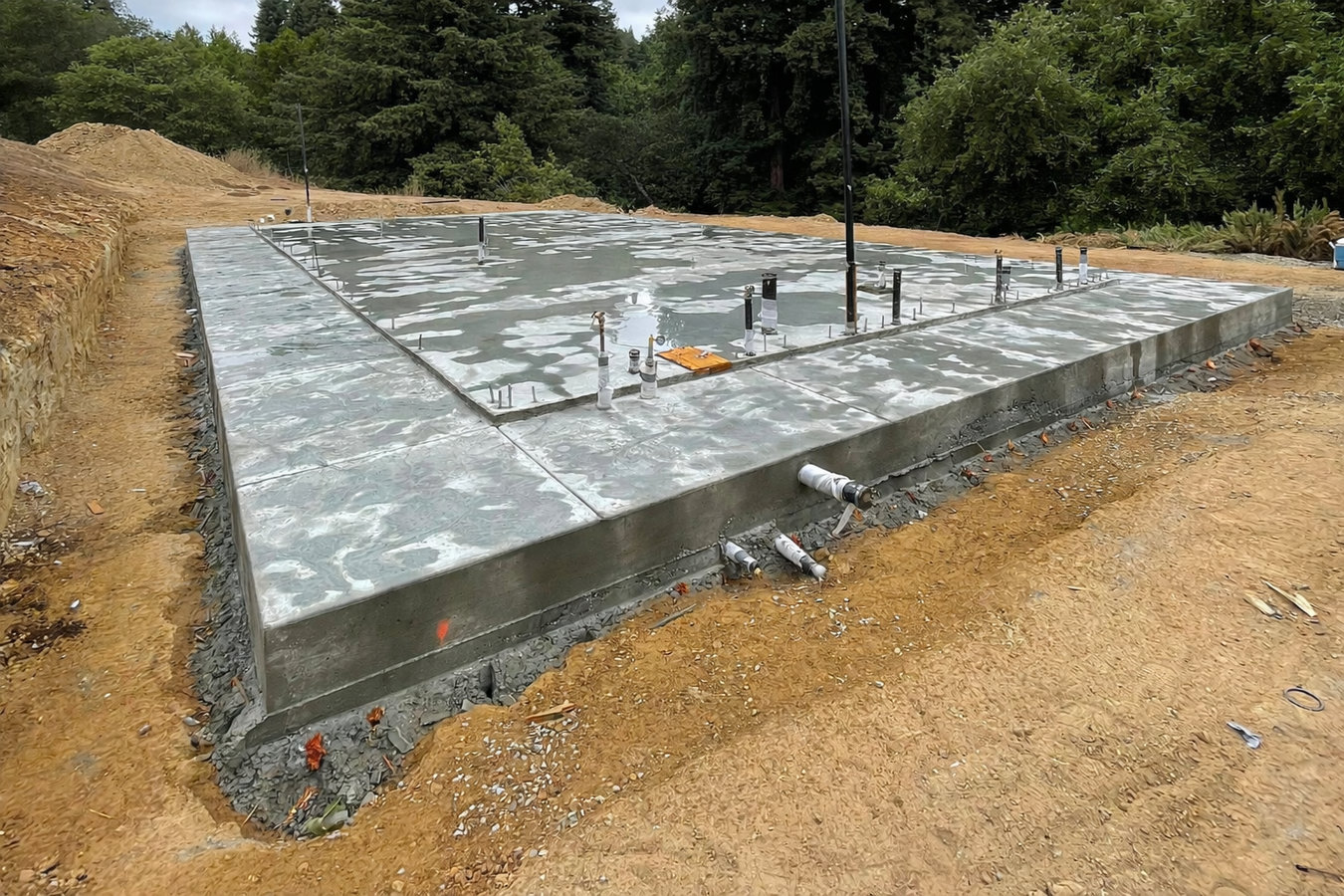
Adding an ADU, garage, or room addition to your Redlands property starts with the right foundation. We build reinforced concrete slab foundations designed for local clay soil conditions, with full permit handling through the City of Redlands.
Slab foundation building in Redlands, CA begins with grading and compacting the soil, laying a gravel base and moisture barrier, setting steel reinforcing bars inside wooden forms, and pouring the concrete - most residential slabs take one pour day plus three to six weeks total when you include permitting and curing time.
In Redlands, slab foundations are the standard choice for new construction because the dry climate makes crawl spaces unnecessary and the cost is lower than raised foundation alternatives. That said, the clay-heavy soils throughout the Inland Empire require more careful soil prep than you would find in other parts of the country. A slab poured on poorly compacted clay will develop cracks within a few years as the soil moves with seasonal moisture changes.
Many Redlands homeowners adding an ADU or room addition pair their slab with concrete footings to support load-bearing walls - both can be permitted and poured in a coordinated sequence to keep the project moving.
If you are adding a garage, workshop, ADU, or room addition to your Redlands property, you will need a new slab before any framing can begin. In Redlands, where many homeowners are adding ADUs to older properties, this is one of the most common reasons to call a concrete contractor. There is no existing foundation where you need one - that is the starting point.
Small hairline cracks in a concrete slab are normal and usually harmless. But if you notice cracks wider than about a quarter-inch, cracks where one side is higher than the other, or cracks that seem to be getting longer over time, the slab may need to be replaced rather than patched. In Redlands, the clay-heavy soils that shift with seasonal moisture changes are a common cause of this kind of progressive cracking.
When a slab settles unevenly - often because the soil beneath it was not properly compacted or has shifted - the structure above it shifts too. If interior doors that used to swing freely are now sticking, or if you notice gaps forming between your walls and ceiling, the foundation may be moving. This is worth having a contractor look at before the problem gets worse.
If your tile, hardwood, or laminate flooring feels damp, shows water stains, or is buckling near the edges, moisture may be coming up through the slab from below. In Redlands, this can happen after heavy winter rains when the ground becomes saturated. It often means the original vapor barrier was inadequate or has failed, and in some cases the slab itself needs to be replaced.
We pour residential slab foundations for new structures, room additions, detached garages, and ADUs throughout Redlands and the surrounding Inland Empire. Every slab we build includes thorough soil compaction, a compacted gravel base for drainage, a moisture barrier, and steel reinforcing bars sized for the load above. We pull all required permits through the City of Redlands Building and Safety Division - you should never have to visit the permit office yourself. If your project also involves concrete footings for load-bearing walls, we coordinate both in the same permit application and pour sequence.
We also handle full slab replacements on existing properties where the current slab is cracked, settled, or was originally poured without adequate reinforcement. Older Redlands homes from the 1920s through 1960s are especially likely to have slabs that no longer meet current standards - particularly if additions have been made over the decades. If your project involves converting a covered patio or carport into living space, we can assess whether the existing slab qualifies or whether a new pour is required.
For ADUs, garages, workshops, and room additions on bare ground. Fully permitted, reinforced, and compacted for Redlands soil conditions.
For homeowners replacing a cracked, settled, or under-reinforced existing slab. Demolition, new pour, and cleanup included.
For patios or carports being converted into living space or permitted accessory units. Assessed and upgraded to meet residential foundation standards.
The Inland Empire sits on expansive clay soils that behave differently from the sandy or loamy soils found elsewhere in California. Clay swells when it absorbs moisture during winter rains and contracts as it dries out in summer - a cycle that repeats every year and puts cumulative stress on any concrete slab poured without adequate prep work. Redlands is also in an active seismic region, which means California building code requires specific reinforcement details and anchor bolt placements that go beyond what is standard in lower-risk states. The California Geological Survey documents these soil and seismic hazard zones across the region, and any foundation contractor working in Redlands should be familiar with both. Redlands also has a significant number of homes built before 1960 where additions and ADUs are now being added - projects that often require a soil assessment and engineering review before a permit will be approved.
Redlands summers regularly push above 95 degrees, and extreme heat can cause freshly poured concrete to dry too quickly on the surface before the slab cures properly underneath. We schedule summer pours for early morning and follow the hot-weather guidance published by the American Concrete Institute to protect the finished product. Homeowners in Yucaipa and Highland deal with the same clay soil and heat conditions, and we serve both communities regularly.
We reply within one business day. We will ask a few basic questions - project type, size, and timeline - and schedule an on-site visit. We do not give firm quotes over the phone, because soil conditions and lot access vary too much to price accurately without seeing the property.
We walk your lot, assess the soil, check equipment access, and review any existing structures nearby. You receive a written, itemized estimate before we ask for any commitment. Every line - permits, grading, rebar, cleanup - is listed separately so you understand exactly what you are paying for.
We submit the permit application to the City of Redlands Building and Safety Division. Plan for one to three weeks for permit review. Once approved, we schedule the work and confirm what you need to clear from the site before the crew arrives.
We grade, compact, and set forms and rebar before a city inspector visits to verify the reinforcement placement. The concrete pour follows inspection approval - typically a one-day pour for a residential slab. We manage curing during the following days, including early morning scheduling and curing compounds during summer heat.
Permit timelines in Redlands can add two to three weeks - the sooner we submit your application, the sooner your project is done. No pressure, just a written estimate you can compare.
(909) 546-5311Your contractor is legally required to pull their own permits for foundation work in California. We submit the application to the City of Redlands, schedule the required inspections, and close out the permit when the job is done - you do not make a single call to the building department. Permitted work protects your home's value when you sell or pull a future permit.
Clay soil in the Inland Empire expands and contracts with every wet and dry cycle. We compact to the depth required for your specific lot and grade for drainage away from the slab edge - the two steps that matter most for long-term slab stability here. We ask every contractor we quote against the same question so you can compare their answers.
Redlands is in an active seismic region of Southern California, and California building code requires specific rebar placement and anchor bolt details that go beyond what is required in most other states. We build to those standards on every project - and the city inspector verifies it before the pour. The permit process exists partly for this reason, and we respect that.
Concrete poured above 90 degrees without extra care can look fine on the surface while being weaker underneath. We schedule Redlands summer pours for early morning and use curing compounds or wet coverings during the critical first days. The American Concrete Institute provides specific hot-weather guidance that we follow on every warm-weather job.
These are not abstract promises - they are the specific things that separate a slab that holds up for decades from one that develops problems within a few years. Every project we take in Redlands gets the same attention to permit compliance, soil prep, and pour management regardless of size.
Full foundation installation for new homes and major additions - from excavation and soil assessment through final inspection and permit closeout.
Learn MoreReinforced concrete footings for load-bearing walls, fences, and structures that need a deeper anchor point than a standard slab provides.
Learn MorePermit review at the City of Redlands can take one to three weeks - call or submit a request today and we will get the application moving while the schedule is open.